This past week, we continued to cut pieces for the chassis and assembled them. Along the way, we encountered a few problems such as cutting parts the wrong size and not making certain parts completely identical. This set us back a bit, but we were able to get everything cut correctly and assembled a little while later. While the chassis was getting built, our programming team was able to get the electronics wired and working. Additionally, they were able to program the basic robot functions: driving, shooting, and lifting.
With our business group, we finished writing both the Chairman’s and Woodie Flowers essay submissions and successfully submitted both by the deadline. We also continued to design our t-shirts and buttons.
While we had a few setbacks this week, we were still able to make a lot of progress on with our robot. Through our mistakes, members have been able to learn several valuable lessons, including, “Measure twice, cut once!”
With our business group, we finished writing both the Chairman’s and Woodie Flowers essay submissions and successfully submitted both by the deadline. We also continued to design our t-shirts and buttons.
While we had a few setbacks this week, we were still able to make a lot of progress on with our robot. Through our mistakes, members have been able to learn several valuable lessons, including, “Measure twice, cut once!”
On the third week of build season, we started to work on finishing the shooter frame and cut pieces for the robot chassis. At the beginning of the week, our team had a more finalized design of the robot and started to work on building the chassis and fabricating different parts. We tweaked the shooter a little bit from the previous design we had to provide more movement for the joints. One of the more common points of the week was to have people crowding around a computer screen looking at the robot model in CAD (Computer-Aided Design). Starting to build the chassis was fun and it presented many tasks that could be done at once, which gave every member an opportunity to be even more involved with the production of the robot.
On the business side of things, we progressed forward with the writing of the Chairman’s and Woodie Flowers award submissions. We also voted upon a t-shirt design and started to draw it in illustrator.
This second week of build season, we continued to improve our shooter and started figuring out the different angles for shooting. We also continued designing our robot in CAD and figuring out the dimensions and angles for the different parts and fitting them all together. Towards the end of the week, we had many parts in the process of being built.
Apart from the robot side of things, our team also started working on the marketing and business-related items, such as writing the Chairman’s essay and drawing t-shirt designs.
At the end of the week, our progress was delayed for about three days when a small ice storm hit the area. While we couldn’t work on the robot over that time, we were still able to work a lot on our t-shirt designs and essays. Overall, we were able to get a lot done this week despite a couple of challenges.
During this first week of the build season, we have worked hard at the build space, strategizing, designing, prototyping, and testing programming for our robot. The first couple days, we met with a couple other teams and brainstormed strategies. Once we figured out how we wanted to play Stronghold, we started working on drawing up plans for the robot and then started prototyping separate parts to test. The main piece we worked on was a shooter. We built one early on and tested different speeds and angles with various components.
So far, we have had a couple of issues, including building the shooter incorrectly at one point, but that gave us valuable learning moments and we were able to progress forward shortly after. By the end of the week, the shooter was working well and our programmers were also able to get vision tracking working.
The energy was high as hundreds of high school students and mentors gathered together at Orange High School in Hillsborough, NC, and eagerly waited to watch the 2016 FRC game broadcast. Everyone was anticipating what the new challenge was all about, using the teaser video FIRST released a few months prior. After a long introduction and several teasers, the new game was revealed: Stronghold.
Stronghold is a game where two alliances composed of three robots work to conquer their opponent’s alliance’s kingdom. On each side, there is a castle tower with goals both at 9-feet and right on the ground. Each alliance has the option to start off with a total of three “boulders,” which are 10-inch diameter foam balls. With those boulders, the alliances score by launching them into the high goal for 5 points or rolling/pushing them into the low goal for 2 points. Of course, there is a twist. As robots are scoring down field, opposite where their drive stations are, they are required to shoot the boulders from their opponent’s courtyard, a section by the goals they are shooting into. To get to the opponent’s courtyard (the other end), robots have to cross a row of assorted “defenses”, which are obstacles. When a defense is crossed twice in the right direction, it become “damaged”; once 4 defenses are damaged, the alliance has “breached” the “outer works” (row of obstacles) and points are scored. In the last 20 seconds of the game, robots can score extra points and climb on a bar nearly 7 feet off the ground at their opponent’s castle. For a more detailed explanation of the game and animation, check out the official game reveal video below.
After the video was played, our team quickly gathered together to read the rules and started developing strategies. We also joined a few other teams in a brainstorming session. By the end of the day, we had a general idea of we wanted to play the game and were very excited to get working on a robot for Stronghold!
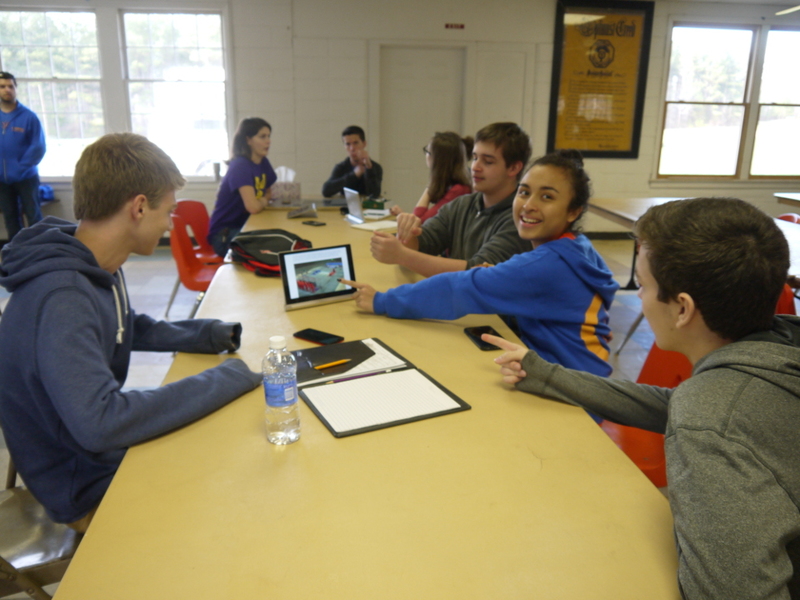
At the beginning of the year, our team spent the afternoon with FRC Team 3229, Hawktimus Prime, and did a “mock kickoff” to better prepare for the official the following week. For the first portion of the afternoon, we went over tips on what to focus on and look at first when starting the robot build process. Afterwards, the mentors selected the 2006 FRC game, Aim High, and had our two teams work with each other in smaller groups to come up with strategy, using what we learned from the strategy tips session. Later on, each group shared the strategies they had come up with and then started working on ideas of robot designs. This experience helped Hawktimus Prime, our team, and the new team members, especially, know what to expect at a kickoff as well as know what to do and look for when analyzing a new FRC game.



Recent Comments